
New Newcastle University modelling puts one in eight spilled pellets still in the Tyne estuary in late August. Autumn high flows could flush them out.
About 2.2 tonnes of the plastic pellets spilled into the River Tyne in July were probably still in the estuary six weeks later, according to new modelling by Newcastle University. That is around one in eight of the pellets released, and it is the amount left after allowing for everything the clean-up teams took out.
The researchers now warn that the higher river flows of autumn and winter could flush that material downstream, and they are urging the organisations running the response to consider catching it before they do.
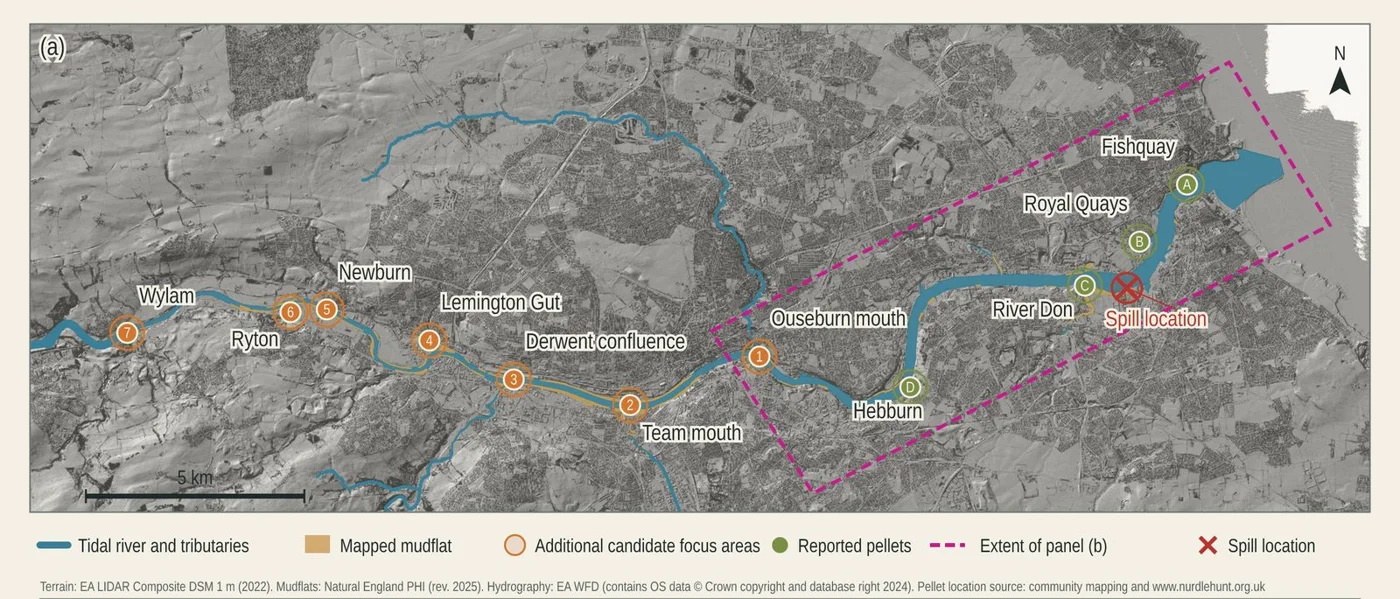
The spill happened on 19 July, when a vessel collision at the Port of Tyne released an estimated 17 tonnes of nurdles into the river: around 850 million pellets, the university says. The modelling was developed as part of advice to the Scientific and Technical Advice Cell (STAC), the expert group advising the agencies managing the incident. The team presented it to STAC on 8 September and updated it on 16 September, according to the project’s own write-up, published on 5 October.
Most went to sea, a share stayed
Pellets began leaving the river on the first day of the spill. By 3 August, around 62% had gone, the university says, and most were carried out to sea within a few weeks.
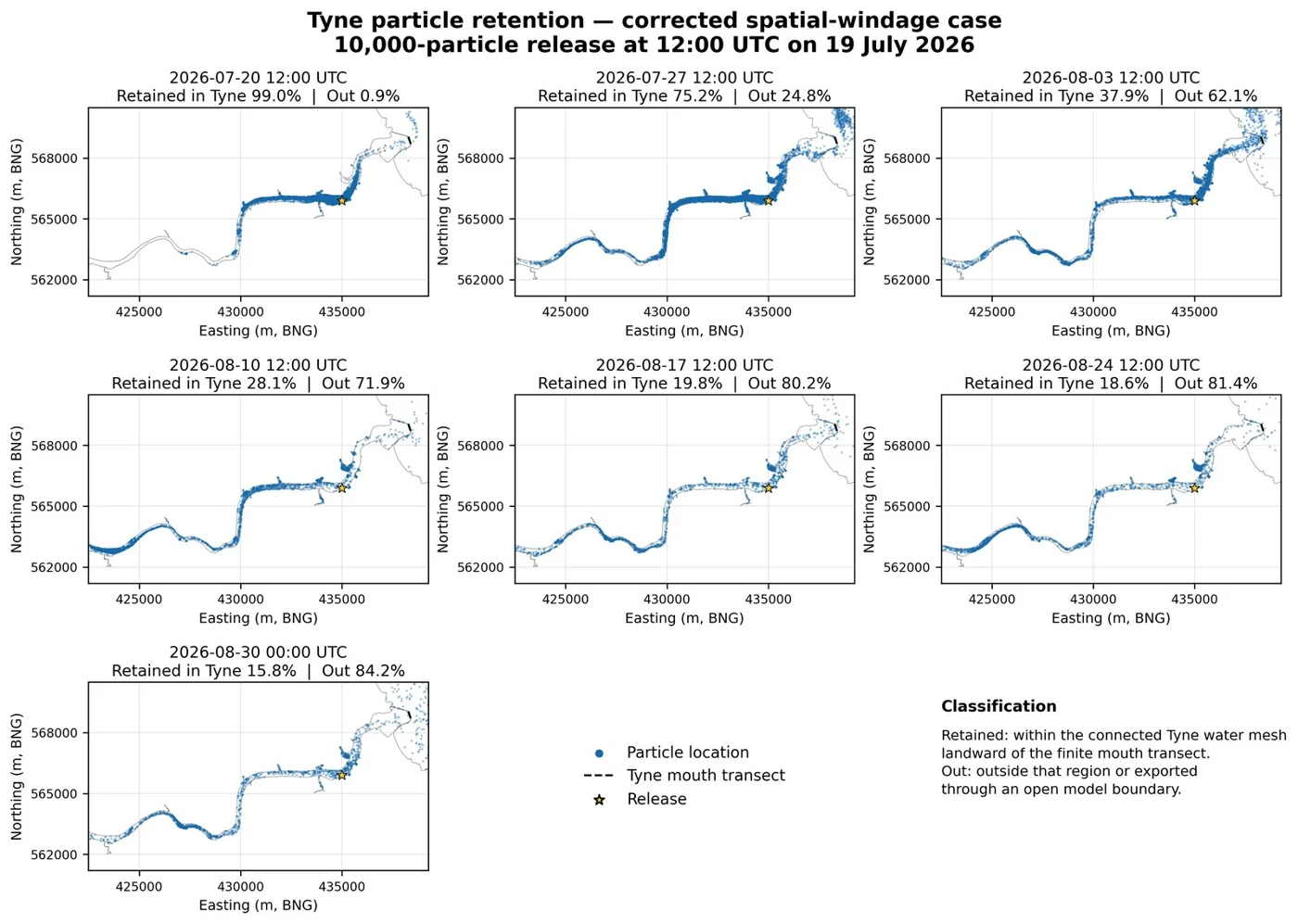
A substantial share did not leave. By 30 August, 16% were still inside the estuary. The project’s figures show the decline step by step, measured as the share of 10,000 simulated particles still in the Tyne, before any allowance for recovery:
- 20 July: 99.0% still in the river
- 27 July: 75.2%
- 3 August: 37.9%
- 10 August: 28.1%
- 17 August: 19.8%
- 24 August: 18.6%
- 30 August: 15.8%
The team then took account of the clean-up. Rather than subtract the total recovered at the end, it removed pellets from the model on the dates they were actually collected, “because some of the pellets collected early on would otherwise have been carried out to sea”. On that basis, about 2.2 tonnes remained on 30 August.
The modellers say they deliberately set a low chance of pellets sticking to the banks, “so the model is more likely to underestimate the pellets held along the banks than to overestimate them”.
Why the autumn matters
River flows in the Tyne have generally been low from July to the end of September, so pellets that drifted up the estuary have had little to push them on. The researchers expect a significant increase in high-flow events in autumn and winter to mobilise some of them. They “strongly recommend” that measures to intercept, trap or recover the nurdles are considered before then, at places where that can be done safely and effectively.

Dr Matt Perks, who leads the university’s research project into the spill, said:
“Because river flows have been so low since July, pellets that moved up the estuary and were deposited have had little to move them on. When elevated river flows arrive, some of that material is likely to be flushed downstream, so now is the time to consider where it could be intercepted. Over the coming months our fieldwork will measure directly how pellets move with the tide, which will let us test and improve these predictions.”
The project is open about the limits of this. Its write-up says the warning is “an inference from the modelling: we haven’t yet simulated the effect of high river flows”. It adds that the amount still in the estuary also supports continued monitoring and recovery there.
How the model works
The team built a computer model of the tidal Tyne and the neighbouring North Sea, covering tides, river flow, wind and waves. Before relying on it, they checked it against real tide measurements: the project says it matches the timing and size of the tide at North Shields to within 8cm on average, and upstream at Gateshead to within 15cm. They then released 10,000 virtual particles at the time and place of the spill and followed them for two months.
Dr Seb Pitman, Senior Lecturer in Physical Geography at Newcastle University, who built the model, said:
“Our model reproduces the tide through the Tyne very closely, which gives us real confidence in what it says about the estuary itself. Even after allowing for everything the clean-up teams recovered, more than two tonnes of pellets were still in the river six weeks after the spill. Where the rest went at sea is much less certain, and we’ve been careful to present those maps as possibilities rather than predictions.”
Where the pellets went at sea: far less certain
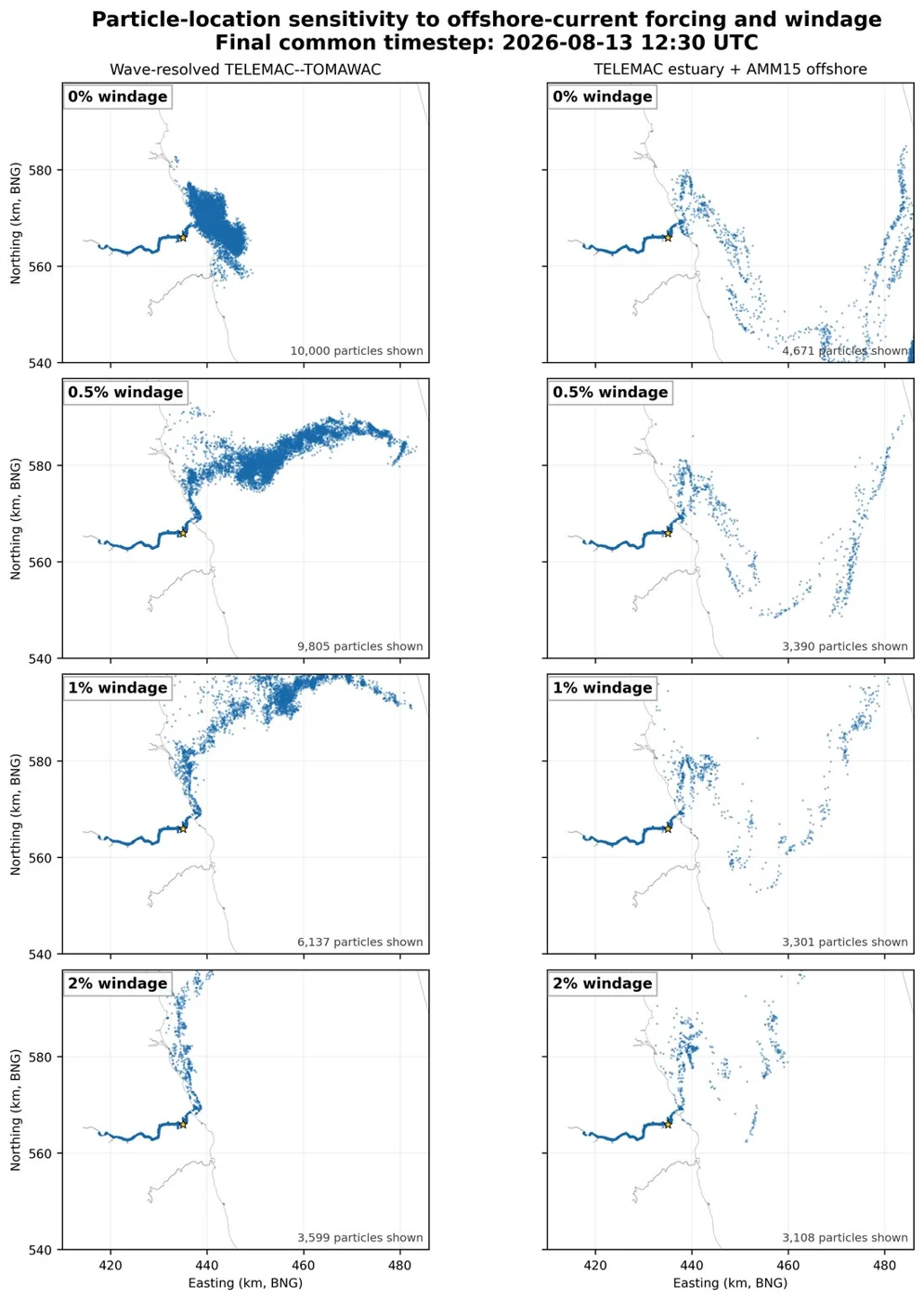
Once pellets left the river, their paths depended heavily on ocean currents and on how hard the wind pushed the floating pellets. Different, equally reasonable assumptions produced markedly different offshore patterns, so the researchers say their maps are possible scenarios, not a record of where individual pellets went.
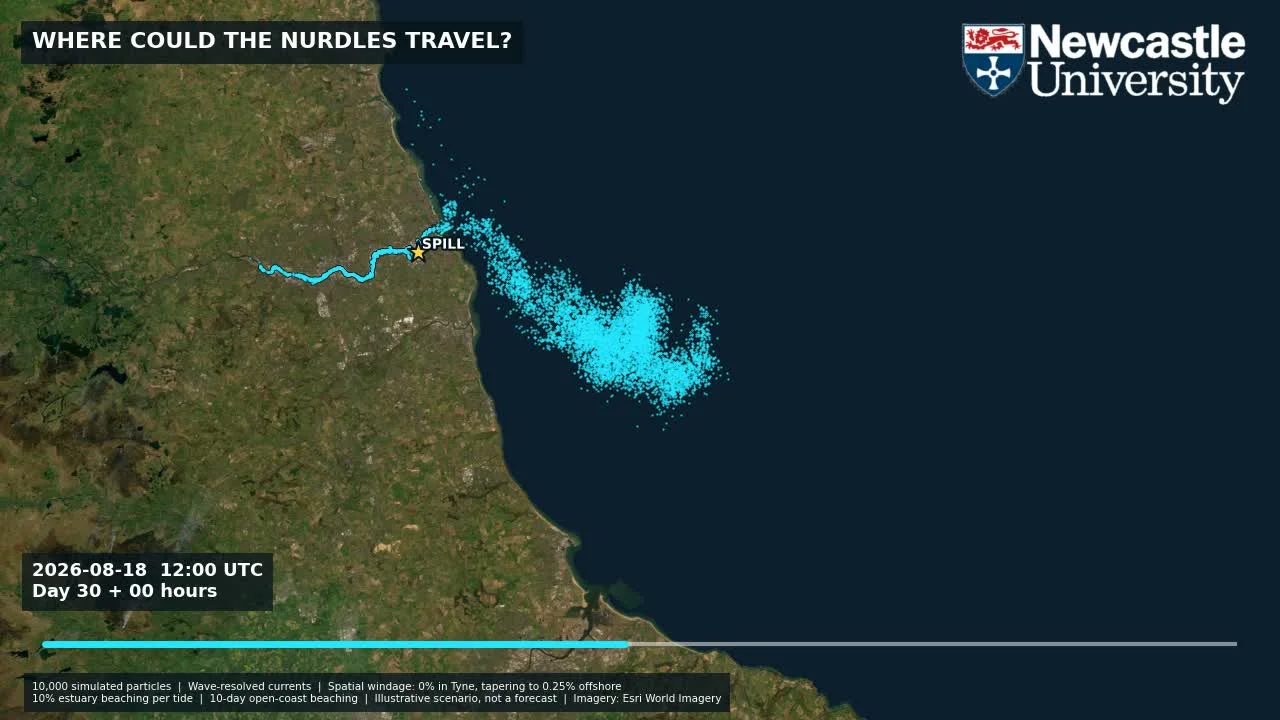
In one plausible scenario, shown in the animation below, pellets move first towards northern shores in early August and then shift south over the following weeks. The university says that broad pattern appears consistent with recoveries reported along the coast. The project cautions that this does not prove the assumptions are right, because recovery records also depend on where people searched, what they could reach and what they reported.
The model also cannot say whether pellets are present or absent on any particular beach or riverbank. “A modelled absence isn’t evidence that no pellets are there,” the project says, “and a modelled arrival doesn’t prove pellets were deposited.”
What happens next
More modelling over the coming weeks will test the effect of turbulence, wind and how pellets behave at the shoreline, and the results will be compared with recovery records. The university’s project, Against the flow, starts fieldwork this autumn: drone surveys, net sampling over full tidal cycles, sediment sampling and laboratory analysis of recovered pellets. The project says the work is funded by the Natural Environment Research Council and run with the University of Liverpool.
What it means for you
If you walk the beaches at Whitley Bay, Cullercoats, Tynemouth or the Fish Quay, your sightings are useful evidence, including the times you looked and found nothing. The researchers ask the public to report where and when they have seen nurdles, or searched and found none, at tynenurdles.org.uk/submit. The project says a phone photo records exactly what it needs.
The full write-up, with the animation, is at tynenurdles.org.uk. To report a pollution incident, the project gives the Environment Agency’s 24-hour hotline: 0800 80 70 60.
For the clean-up itself, our report of 7 October has the official recovery figures, and our earlier story covers where to take any pellets you find.
Have your say