
Only 54% backed the summer beach dog ban in a 618-response consultation, but the council plans to keep all three public space orders until October 2029.
The rules that ban dogs from designated North Tyneside beaches each summer, require them to be picked up after everywhere, and let officers stop street drinking are set to run for another three years. North Tyneside Council’s Cabinet is asked on Monday 21 September to extend all three of the borough’s Public Space Protection Orders to October 2029. Without that decision they expire at midnight on 19 October 2026. (Cabinet report, 21 September 2026)
The orders were first made in October 2017 and have already been extended twice, in 2020 and 2023. The law caps each extension at three years, which is why the question comes back to Cabinet now.
The beach ban divides the coast
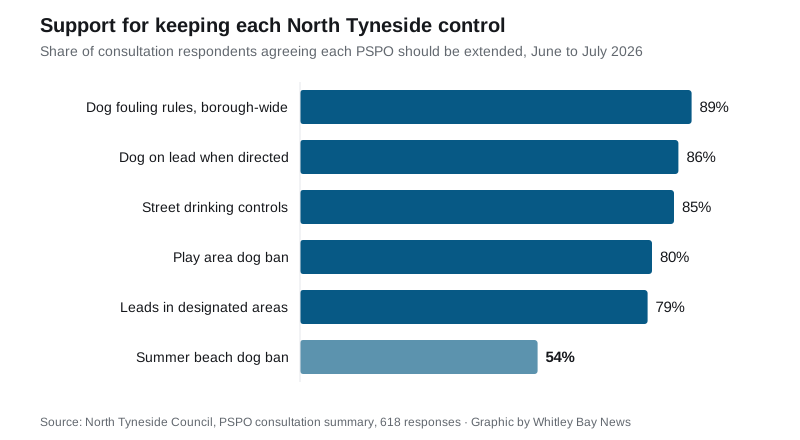
A four-week public consultation ran from 20 June to 17 July and drew 618 responses. Five of the six controls won support of 79 per cent or more. The exception was the seasonal beach ban, which excludes dogs from designated beach areas between 1 May and 30 September: 336 respondents (54 per cent) backed it and 245 (40 per cent) opposed it. (Consultation results summary)
The most common request, made in around 200 comments, was for timed access instead of an all-day ban, letting dogs on before 9am or after 6pm. Around 165 comments called blanket bans unfair to responsible owners, while a smaller group of about 90 wanted the bans kept or extended year round.
The council is recommending no change. The report says designated summer exclusion zones provide “clarity for all users” and minimise conflict between people who want dog-free sand and those who walk dogs daily. Protecting wildlife, particularly the seals and birds around St Mary’s Island, was one of the strongest recurring themes in favour of keeping controls.
What the three orders do
- Dog fouling: applies to every open public space in the borough. Owners must remove it immediately; not noticing, or having no bag, does not count as a reasonable excuse.
- Dog control: bans dogs at all times from 55 mapped children’s play areas, bans them from four mapped beach areas between 1 May and 30 September, requires leads in 14 mapped areas, and lets a police officer or council officer direct any owner to put a dog on a lead.
- Alcohol: applies borough-wide. It is not a drinking ban; it lets an officer require someone whose drinking is causing a problem to stop and hand over the alcohol. Refusing is the offence.
Breaking any of the orders carries a £100 fixed penalty, reduced to £75 if paid within 14 days, or prosecution and a court fine. Trained assistance dogs are exempt from the dog controls.
Support for the other controls was strong: 89 per cent for the fouling rules, 86 per cent for the power to direct a dog onto a lead, 85 per cent for the alcohol controls, 80 per cent for the play area ban and 79 per cent for designated lead areas. Across every question the loudest theme was not the rules themselves but enforcement; respondents repeatedly said the rules are ignored and wardens are rarely seen. The council points to its Community Protection Officers, Environmental Enforcement Wardens, seasonal Beach Wardens and newly installed AI-enabled CCTV.
No new controls are proposed. The report says the consultation produced no strong or consistent demand for additional orders.
What it means for you
If Cabinet agrees on Monday, nothing changes on the ground: the same beach zones, play area bans, lead areas and drinking controls carry on to October 2029, and the extension orders must then be published with notices in the areas they cover. If you walk a dog on the coast, the summer exclusion ends on 30 September, after which the designated beach areas reopen to dogs until 1 May.
Heading to the coast this autumn? Our things to do in Whitley Bay guide covers the seafront year round, and our parking guide explains the car park rules along The Links and the seafront. We will report Cabinet’s decision once the minutes confirm it.
Have your say